




News & Events
News & Events
News
August 01, 2012
Anacardic acid found to rescue certain ALS abnormalities in experimental drug screening assay using motor neurons from ALS patient-specific iPSCs
Kyoto, Japan, August 1, 2012 - A research group at the Center for iPS Cell Research and Application (CiRA) at Japan's Kyoto University has successfully recapitulated amyotrophic lateral sclerosis (ALS)-associated abnormalities in motor neurons differentiated from induced pluripotent stem cells (iPSCs) obtained from patients with familial ALS, a late-onset, fatal disorder which is also known for Lou Gehrig's disease. In a drug screening assay using the disease model, the team further found that the chemical compound anacardic acid can rescue some ALS phenotypes in vitro.
In a study published online in Science Translational Medicine, Associate Professor Haruhisa Inoue and his team generated motor neurons from iPSCs derived from three ALS patients with mutations in Tar DNA-binding protein-43 (TDP-43). The motor neurons showed cellular phenotypes including vulnerability to stress, shorter neurites, and cytosolic aggregates similar to those seen in postmortem tissues from ALS patients. The team also found that TDP-43 mRNA was upregulated in the ALS motor neurons, which means that TDP-43 autoregulation was disturbed, and that TDP-43 protein in detergent-insoluble form aggregated with the splicing factor SNRPB2 in the nucleus, perturbing RNA metabolism. These findings shed light on the mechanism of disease onset.
Using the motor neurons as a disease model, the researchers discovered that the chemical compound anacardic acid can rescue the abnormal ALS motor neuron phenotypes. For example, when anacardic acid, a histone acetyltransferase inhibitor, was sprinkled on the motor neurons, TDP-43 mRNA expression was decreased, and the length of the neurites increased.
"Our work represents an initial stage of drug screening for ALS using patient-specific iPSCs. TDP-43 is not only relevant to familial ALS but also to sporadic ALS, which represents the majority of ALS cases," said Inoue, a principal investigator at CiRA who is also one of research directors for the CREST research program funded by the Japan Science and Technology Agency. "We will continue to work on ALS patient-specific iPSCs in order to help develop new drug seeds and candidates."
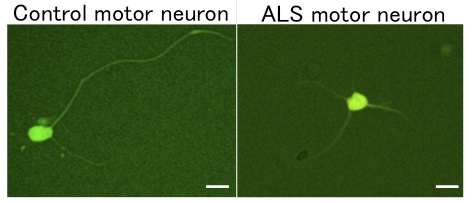
A control motor neuron (left) and a motor neuron derived from
ALS patient-specific iPSCs (right)
COURTESY OF DR. HARUHISA INOUE'S LABORATORY
Paper Details
- Journal: Science Translational Medicine
- Title: Drug Screening for ALS Using Patient-Specific Induced Pluripotent Stem Cells
- Authors:
Naohiro Egawa1,2*, Shiho Kitaoka1,2*, Kayoko Tsukita1,2, Motoko Naitoh3, Kazutoshi Takahashi1, Takuya Yamamoto1,5, Fumihiko Adachi1, Takayuki Kondo1,4, Keisuke Okita1, Isao Asaka1, Takashi Aoi1, Akira Watanabe1,5, Yasuhiro Yamada1,5, Asuka Morizane1,6, Jun Takahashi1,6, Takashi Ayaki4, Hidefumi Ito4, Katsuhiro Yoshikawa3, Satoko Yamawaki3, Shigehiko Suzuki3, Dai Watanabe7, Hiroyuki Hioki8, Takeshi Kaneko8, Kouki Makioka9, Koichi Okamoto9, Hiroshi Takuma10, Akira Tamaoka10, Kazuko Hasegawa11, Takashi Nonaka12, Masato Hasegawa12, Akihiro Kawata13, Minoru Yoshida14, Tatsutoshi Nakahata1, Ryosuke Takahashi4, Maria C. N. Marchetto15, Fred H. Gage15, Shinya Yamanaka1,5,16, Haruhisa Inoue1,2,16**
*: These authors contributed equally to this work
**: Corresponding author - Author Affiliations:
- Center for iPS Cell Research and Application (CiRA), Kyoto University
- CREST, Japan Science and Technology Agency
- Department of Plastic and Reconstructive Surgery, Graduate School of Medicine, Kyoto University
- Department of Neurology, Graduate School of Medicine, Kyoto University
- Institute for Integrated Cell-Material Sciences (iCeMS), Kyoto University
- Institute for Frontier Medical Sciences, Kyoto University
- Department of Biological Sciences, Graduate School of Medicine and Department of Molecular and Systems Biology, Graduate School of Biostudies, Kyoto University
- Department of Morphological Brain Science, Graduate School of Medicine, Kyoto University
- Department of Neurology, Gunma University Graduate School of Medicine
- Department of Neurology, Institute of Clinical Medicine, University of Tsukuba
- Department of Neurology, Sagamihara Hospital
- Department of Neuropathology and Cell Biology, Tokyo Metropolitan Institute of Medical Science
- Department of Neurology, Tokyo Metropolitan Neurological Hospital
- Chemical Genetics Laboratory Molecular Ligand Biology Research Team, Chemical Genomics Research Group, RIKEN Advanced Science Institute
- Salk Institute for Biological Studies
- Yamanaka iPS Cell Special Project, Japan Science and Technology Agency