



News & Events
News & Events
News
May 27, 2026
Unlocking Durable Immunotherapy with Stem Cell-Derived CD4⁺ T Cells
Adoptive T‑cell therapies such as CAR‑T treatment have demonstrated transformative outcomes for certain blood cancers. Yet, their broader application has been limited by challenges, including inconsistent quality, T‑cell exhaustion, and difficulties in large‑scale manufacturing. Although iPS cells offer an attractive solution by providing a renewable, genetically malleable source of immune cells, most prior work has focused on CD8⁺ T cells, traditionally viewed as the primary cytotoxic effectors. In this study, the research team instead turned their attention to CD4⁺ T cells, which are increasingly recognized for their ability to persist long term, resist functional exhaustion, and coordinate immune responses.
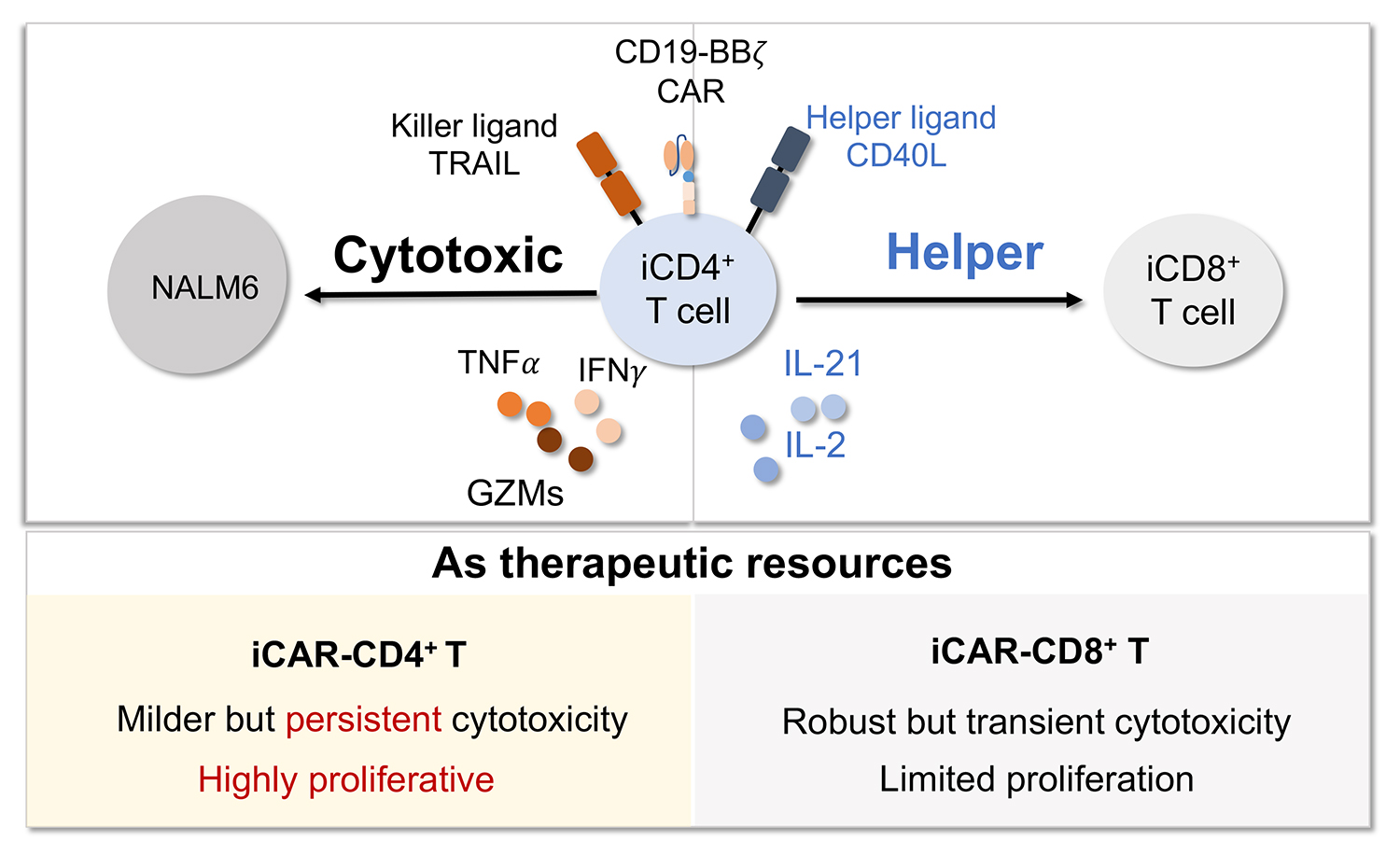
Using an artificial thymic organoid system, the team successfully differentiated human iPS cells into adaptive‑like CD4⁺ and CD8⁺ T cells. These cells displayed key features of conventional T cells rather than innate‑like lymphocytes, addressing a common concern with stem cell-derived immune products. When engineered with a CD19‑specific chimeric antigen receptor (CAR) and tested against a model of acute lymphoblastic leukemia, iPS cell‑derived CD4⁺ T cells showed a unique functional profile: Although their immediate cell‑killing activity was modest compared with CD8⁺ T cells, they maintained robust anti‑tumor activity over repeated rounds of antigen exposure.
Strikingly, CAR‑engineered CD4⁺ T cells outperformed CD8⁺ T cells in long‑term tumor control. Although CD8⁺ T cells rapidly lost function and exhibited signs of exhaustion after repeated stimulation, CD4⁺ T cells continued to proliferate, secrete multiple cytokines, and eliminate leukemia cells while maintaining lower expression of exhaustion‑associated markers across multiple challenges. This endurance was accompanied by a memory‑like molecular signature in the CAR‑engineered CD4⁺ CAR-T cells, suggesting an intrinsic resistance to functional decline. The study also revealed that CD4⁺ T cells possess dual capabilities, acting both as "helper" cells that support immune coordination and as direct cytotoxic effectors capable of killing cancer cells.
The researchers further examined mixtures of CD4⁺ and CD8⁺ CAR‑T cells, a strategy commonly explored in clinical settings. Surprisingly, combining the two subsets did not surpass the performance of CD4⁺ T cells alone in this experimental system. While CD4⁺ T cells provided some support to CD8⁺ T cells, this assistance came at the cost of reduced CD4⁺ T‑cell proliferation and durability. These findings suggest that, while in preclinical experimental settings, CD4⁺ T cells can serve as a viable standalone therapeutic cell population, their optimal use alongside CD8⁺ T cells may depend on context‑specific conditions.
Together, these results position iPS cell‑derived CD4⁺ T cells as a powerful and previously underappreciated platform for next‑generation cancer immunotherapy. By coupling long‑term persistence, resistance to exhaustion, and broad functional capacity with the scalability of iPS cell technology, this approach could help overcome key bottlenecks facing current CAR‑T therapies. The study also provides new insight into how T‑cell lineage and developmental programming shape therapeutic durability, offering valuable guidance for the rational design of future cell‑based treatments.
Paper Details
- Journal: Inflammation and Regeneration
- Title: Adaptive-like CAR-iPSC-CD4+ T cells outperform CD8+ counterparts in sustained ALL control
- Authors: Qingyi Guo1, Chaoqi Zhang1,3, Bo Wang1, Shoichi Iriguchi1, Akihiro Ishikawa1, Atsutaka Minagawa1, Tomoko Ishii1, Yohei Kawai1, Shin Kaneko1,2,3,*
*: Corresponding author - Author Affiliations:
- Center for iPS Cell Research and Application (CiRA), Kyoto University
- Shinobi Therapeutics Inc.
- Transborder Medical Research Center, University of Tsukuba