




News & Events
News & Events
News
May 29, 2026
Overcoming a Key Barrier to iPS Cell-Based T Cell Immunotherapy
Although adoptive T cell therapies, including chimeric antigen receptor (CAR)-T treatments, have shown remarkable clinical success, their durability and consistency often depend on the presence of CD4⁺ helper T cells, which support long-term immune responses and coordinate anti-tumor immunity. While feeder-free protocols for producing CD8⁺ cytotoxic T cells from iPS cells are well established, reliably generating CD4⁺ helper T cells under comparable, clinically compatible conditions has proven difficult. Conventional in vitro differentiation approaches tend to bias developing T cells toward cytotoxic lineages, largely due to excessive T cell receptor (TCR) and Notch signaling that does not faithfully recapitulate physiological T cell maturation.
In this study, the researchers systematically optimized each stage of T cell development from iPS cells by precisely tuning Notch, TCR, and integrin signaling. By withdrawing DLL4-mediated Notch signaling at the peak of the CD4⁺/CD8⁺ stage and avoiding artificial TCR activation during maturation, the team successfully induced robust differentiation into CD4⁺ helper T cells. Additional stage-specific modulation of integrin signaling further improved efficiency and yield. Importantly, the entire process was conducted under feeder-free, two-dimensional culture conditions suitable for large-scale production.
The resulting CD4⁺ iPS cell-derived T cells displayed hallmark features of bona fide helper T cells. They expressed the master transcription factor ThPOK and the effector molecule CD40L, secreted a diverse array of cytokines, and exhibited a naïve to early-memory phenotype associated with strong proliferative capacity and persistence. Single-cell transcriptomic analysis revealed that these CD4⁺ cells formed a relatively homogeneous population and followed a distinct developmental trajectory, arising from double-positive cells through an intermediate early-memory CD8⁺-like state.
Functionally, iPS cell-derived CD4⁺ helper T cells demonstrated potent, antigen-specific helper activity. When equipped with a defined T cell receptor, they efficiently promoted dendritic cell maturation and pro-inflammatory cytokine production in a peptide-dependent manner, outperforming both conventional organoid-derived iPS cell-T cells and TCR-engineered primary T cells. Notably, although initially less cytotoxic than CD8⁺ T cells, the CD4⁺ cells retained the capacity to acquire strong tumor-killing activity after repeated stimulation, while maintaining superior expansion potential.
Together, these findings establish a practical and clinically relevant platform for generating both helper and killer T cells from a single iPS cell source. By enabling the scalable production of highly plastic CD4⁺ helper T cells alongside CD8⁺ cytotoxic T cells, this work advances the development of off-the-shelf iPS cell-based immunotherapies and opens new avenues for designing more durable and versatile cellular cancer treatments.
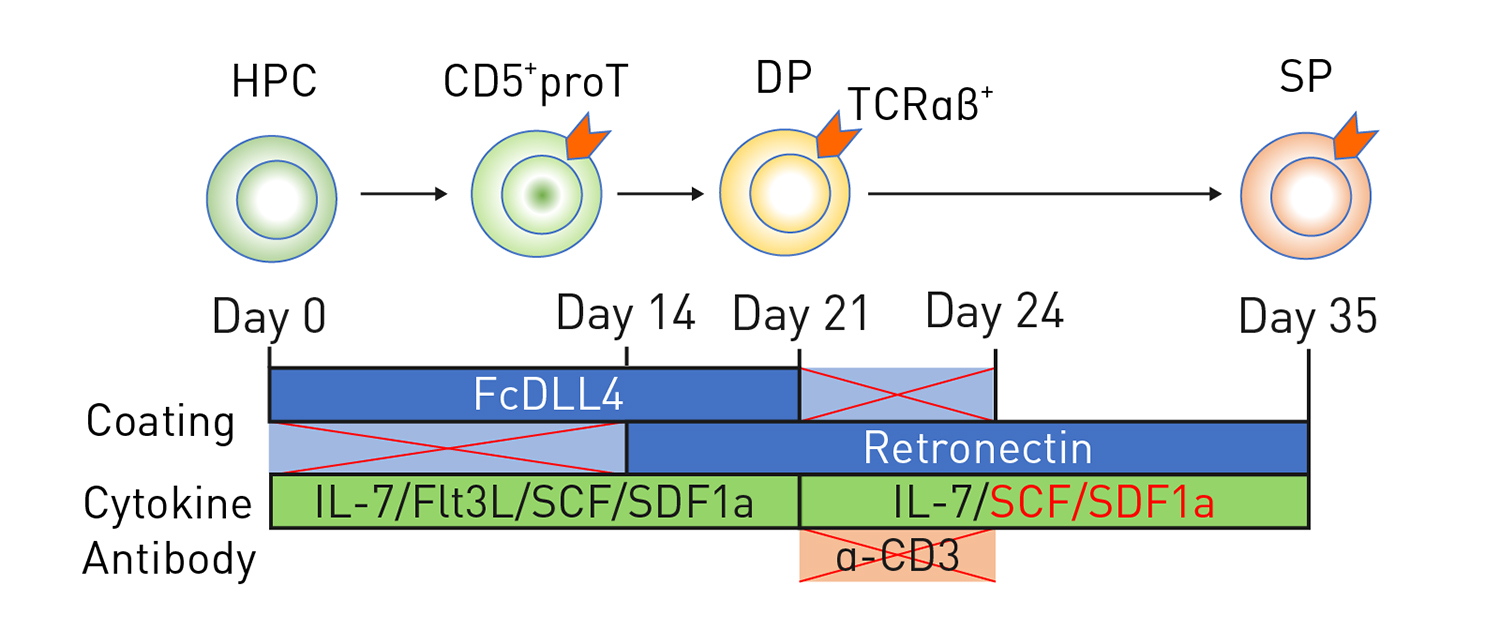
Modified Feeder-free T-cell development
Paper Details
- Journal: Molecular Therapy
- Title: Feeder-free generation of CD4 single-positive helper T cells from human iPSCs via stage-specific modulation of Notch and TCR signaling
- Authors: Yohei Kawai1, Shin Kaneko1,2,*
*: Corresponding author - Author Affiliations:
- Center for iPS Cell Research and Application (CiRA), Kyoto University
- Shinobi Therapeutics Inc.