





News & Events
News & Events
News
July 02, 2026
Catalyzing the Paradigm Shift Towards Personalized Genomic Medicine: Launching the Global Research Network "i2PARADIGM"
Modern medicine has largely taken the "one size fits all" approach, which treats diseases and patients as broad categories and tends to ignore individual differences or rare diseases. As a result, patients who do not fit the average profile might face incorrect diagnoses or adverse drug responses, leading to a loss of well-being or even life-threatening situations.
To resolve these problems, medicine must become more customized based on the patient's unique genome. As emerging technologies, including iPS cell technology, converge, a paradigm shift in medicine is now underway, with the hope that medicine will truly be personalized in the near future.
With funding from the JSPS Core-to-Core Program, CiRA will establish the International Interdisciplinary Program for Advanced Regenerative Applications and Design of Individualized Genomic Medicine (i 2PARADIGM) starting in April 2026. This global research network has strategically assembled core partner institutions from Belgium (Interuniversity Microelectronics Center; imec), Canada (McGill University), through the DNA to RNA (D2R) Initiative—a $165M initiative funded by the Government of Canada through the Canada First Research Excellence Fund to turn genomic discoveries into RNA-based treatments, Singapore (Agency for Science, Technology and Research; A*STAR), and Switzerland (University of Zurich), supported through institutional funding by University Medicine Zurich and UZH Global Affairs Global Champion Fund, to create a sustainable international research hub and cultivate the next generation of scientific leaders in academia, industry, and other sectors to drive and lead the coming era of personalized genomic medicine around the world by combining unique expertise from the core partner institutions.
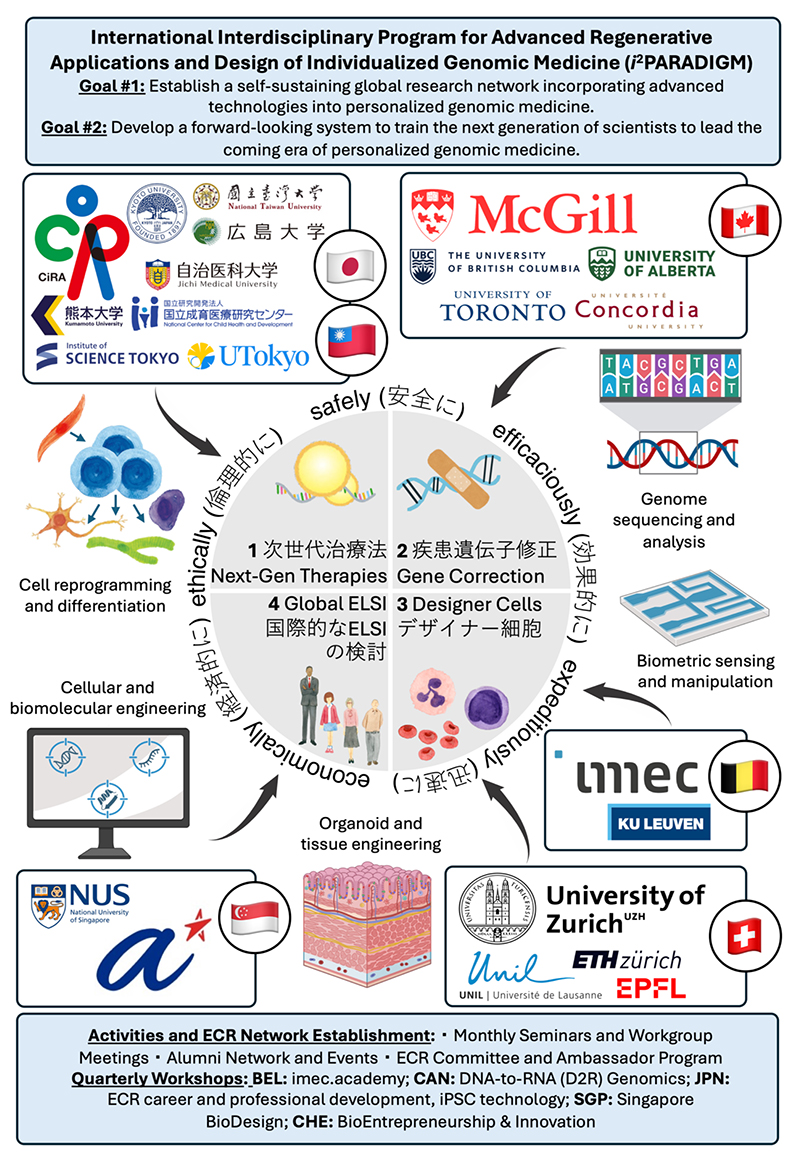
i 2PARADIGM combines CiRA's knowledge in cellular reprogramming and differentiation with the unique expertise from each core institution to propel personal genomic medicine research and applications: genome analysis and engineering from McGill University to leverage large-scale human genomic datasets to understand how genetic variations impact human health and disease states; cellular and biomolecular engineering from A*STAR to correct genetic disorders or create designer cells for personalized genomic medicine applications; tissue engineering, gene and cell therapy, and regenerative medicine from University of Zurich to build functional tissues for advanced disease modeling and transplantation, and nanoelectronics and microfabrication from imec to incorporate advanced diagnostic and manipulation tools at different levels.
In addition to the core partner institutions, the program also includes cooperating participants from the following institutions:
Japan: Hiroshima University, Institute of Science Tokyo, Kyoto University, Jichi Medical University, Kumamoto University, National Center for Child Health and Development (NCCHD), The University of Tokyo
Belgium: KU Leuven
Canada: Concordia University, University of Alberta, The University of British Columbia, University of Toronto
Singapore: National University of Singapore
Switzerland: Ecole Polytechnique Federale de Lausanne, ETH Zurich, Lausanne University Hospital
Taiwan: National Taiwan University
Together, i 2PARADIGM will enable the use of patient genetic information to develop novel mRNA- or protein-based therapeutics and gene therapy delivery tools (Theme 1), the precise correction of disease-causing DNA mutations in vivo or ex vivo in patient-derived cells to alleviate the effects of rare or chronic diseases (Theme 2), the creation and modeling of designer human cells and tissues to better understand disease mechanisms at cellular and molecular levels, validate drug or gene therapy interventions, and for transplantation (Theme 3), as well as a global examination of ethical, legal, and social issues (ELSIs) associated with personal genomic medicine, such as informed consent, privacy and security of vast genomic data, potential genetic discrimination and determinism, and equity in testing and treatment (Theme 4).
The five-year program will primarily consist of short-term research internships abroad for early-career researchers, including graduate and postdoctoral trainees, as well as a combination of in-person and online seminars and workshops on not only scientific training but also entrepreneurship, communications, leadership, and management skills.
Program Coordinator:
- Knut Woltjen (Associate Professor, CiRA Department of Life Science Frontiers)
Core Partner Coordinators:
- Dries Braeken (Scientific Director, imec)
- Guillaume Bourque (Professor, McGill University)
- Adrian Kee Keong Teo (Senior Principal Investigator, A*STAR)
- Simon P. Hoerstrup (Professor, University of Zurich)
Program Manager:
- Kelvin Hui (Deputy Head, CiRA Research Promoting Office)
More details will be available on the i 2PARADIGM website: